
The Hidden Financial Leak in Your Business: Outstanding Receivables
- 17th August, 2026
- Abhishek Premkumar
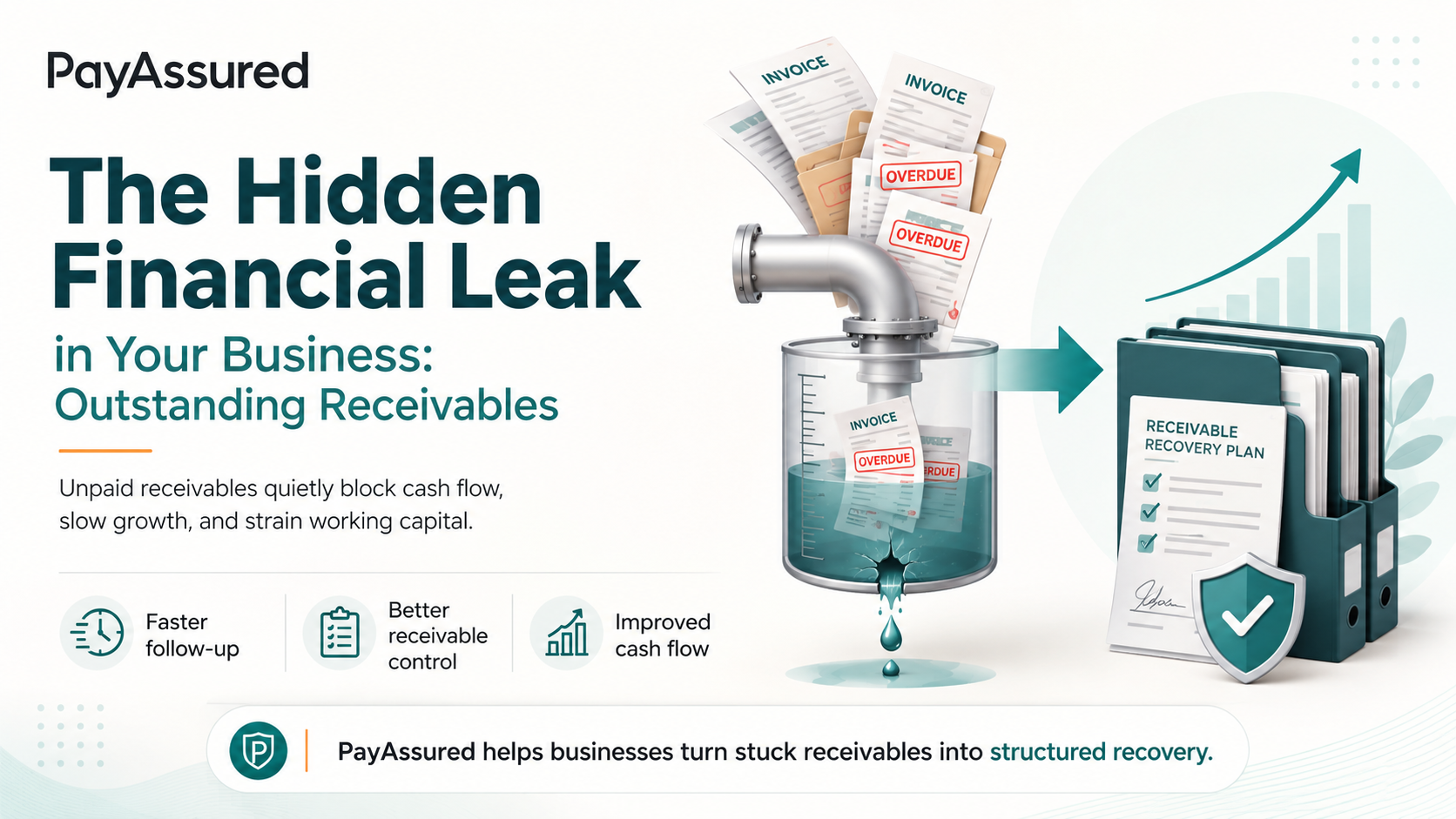
Every business keeps track of its expenses. Rent, salaries, vendor payments, software costs, logistics, taxes and operational expenses are all watched closely because they directly affect profit. But there is another financial leak that many businesses fail to notice early enough. It does not always appear as an expense in the usual way, but it silently drains the company’s strength.
That leak is outstanding receivables.
Outstanding receivables are amounts that a business has already earned but has not yet received. The work is completed, the goods are supplied, the invoice is raised, and the revenue may even appear in the books. But the money has not entered the bank account. On paper, the business looks successful. In reality, its cash flow may be under pressure.
This is one of the biggest challenges for Indian businesses, especially MSMEs, service providers, manufacturers, distributors and B2B companies. Many of them are not struggling because they do not have customers. They are struggling because their customers are not paying on time. The business continues to operate, but a part of its working capital remains stuck with debtors.
At first, outstanding receivables may not look dangerous. A client may delay payment by a few days. The finance team may say the payment is under process. The buyer may request some time. The supplier waits because the relationship matters. But when the same pattern continues across multiple invoices or multiple clients, the impact becomes serious.
A business can lose money without realizing it. When payments are delayed, the company may be forced to use overdraft facilities, borrow funds, delay vendor payments or use internal reserves. Even if the invoice is eventually paid, the delay has already created a cost. The business has lost time, liquidity and financial comfort.
The real problem with outstanding receivables is that they are easy to ignore. Since the amount is technically due, many businesses assume it will come eventually. They continue to treat it as pending money rather than a risk. But the longer an invoice remains unpaid, the more uncertain recovery becomes. A 15-day delay may be manageable. A 60-day delay becomes a concern. A 90-day delay needs serious attention. Beyond that, the invoice may start moving towards bad debt if there is no structured action.
Outstanding receivables also affect decision-making. A company may hesitate to take new orders because it does not have enough working capital. It may delay expansion, hiring or marketing because money is stuck. It may lose bargaining power with vendors. It may even damage its own credit reputation if it cannot make payments on time. In this way, one company’s delayed payment creates pressure across the entire business chain.
This is why receivables should not be treated only as an accounting entry. They should be treated as a business health indicator. A company with high receivables may look profitable, but if those receivables are not being collected, the business is carrying hidden risk.
PayAssured helps businesses identify and control this risk.
Instead of allowing outstanding invoices to remain stuck in informal follow-ups, PayAssured brings a structured recovery approach. The process begins by reviewing the unpaid invoices, the age of the dues, the debtor’s behaviour, the available documents and the past communication. This helps the business understand whether the receivable is simply delayed or whether it has already become a serious recovery case.
Many businesses do not have a clear internal system for escalation. The sales team may keep following up politely. The accounts team may send reminders. The founder may personally call the client. But if there is no structured process, the debtor may continue delaying payment without any real pressure. PayAssured helps change this by creating a professional recovery path.
Documentation is an important part of this process. Invoices, purchase orders, delivery proofs, ledgers, email confirmations, WhatsApp messages and payment promises all help strengthen the recovery position. When these documents are organized properly, the claim becomes clearer and more difficult for the debtor to ignore.
PayAssured also helps businesses decide the right level of action. Some cases may need firm follow-up. Some may need a settlement discussion. Some may need a repayment plan. Some may require legal-backed communication or further escalation. The objective is not to create unnecessary conflict, but to recover dues in a structured and practical manner.
The biggest advantage of acting early is that it protects cash flow. When businesses wait too long, the debtor becomes comfortable delaying. Urgency reduces, documents become harder to track, and recovery becomes more complicated. Early recovery action keeps pressure alive and increases the chances of faster resolution.
Outstanding receivables are not harmless. They are money that belongs to the business but is not available for use. They restrict growth, increase stress and weaken financial planning. The longer they remain pending, the more damage they cause.
For Indian businesses, strong receivable management is no longer optional. It is part of financial discipline. Companies that monitor overdue invoices, act early and use professional recovery support are better placed to protect their working capital.
PayAssured is built to help businesses close this hidden financial leak. It helps them move from waiting to action, from scattered follow-ups to structured recovery, and from blocked receivables to improved cash flow.
Because in business, revenue is not enough. What truly matters is the money recovered, available and working for the company.