
Are Your Receivables Becoming Bad Debts? Warning Signs Every Business Must Know
- 19th August, 2026
- Rithik Raj
For every business, receivables are expected to become cash. An invoice is raised with the belief that payment will come within the agreed time. The amount is recorded in the books, revenue is counted, and the business continues its operations assuming that the money will soon be available.
But not every receivable turns into cash.
Some receivables slowly begin to lose their certainty. What starts as a delayed payment may become a repeated follow-up. What begins as a temporary issue may turn into months of excuses. Over time, an unpaid invoice can quietly move from being a normal receivable to becoming a bad debt risk.
This is one of the biggest challenges businesses face. On paper, the money is still due. The invoice still exists. The client may still say that payment will be made. But in reality, the chances of recovery may be reducing every week.
Many businesses fail to identify this shift early enough. They continue treating the amount as pending receivables, even when the debtor’s behavior is already showing warning signs. By the time the company realizes that the amount may not come easily, too much time has already passed.
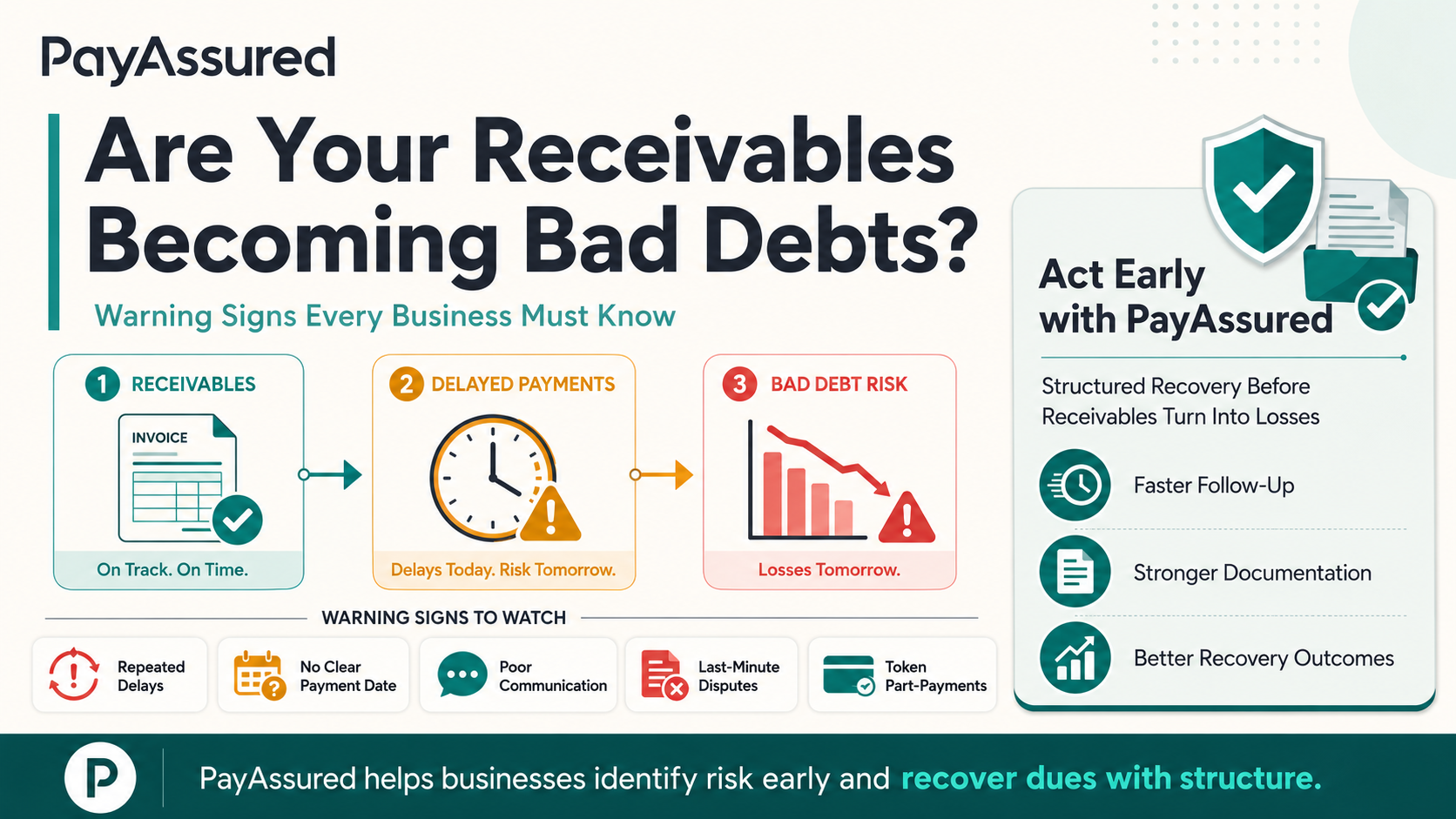
The first warning sign is repeated delay without a clear reason. A genuine delay may happen in business, but when the same client keeps saying “next week,” “approval is pending,” or “payment under process” without giving a firm date, the receivable needs closer attention. Vague promises may sound polite, but they do not protect cash flow.
Another warning sign is poor communication. When the debtor stops responding to calls, delays email replies, avoids meetings or keeps transferring responsibility to different people, the risk increases. A paying client usually keeps the conversation clear. A debtor who wants to delay often keeps the conversation unclear.
Receivables also become risky when the client starts raising issues only after payment becomes due. If quality concerns, documentation objections, invoice disputes or service-related complaints appear suddenly after repeated reminders, the business must treat the matter carefully. Sometimes these issues may be genuine. But in many cases, delayed objections are used to avoid or postpone payment.
A further warning sign is when the debtor makes small token payments without a clear settlement plan. While part-payment may look positive, it can also become a way to buy time. If there is no written commitment for the remaining amount, the business may continue waiting without real progress.
The age of the invoice is also important. A 15-day delay may be manageable. A 60-day delay becomes concerning. A 90-day delay should be treated seriously. Once receivables remain unpaid for too long, the chances of quick recovery usually reduce. Documents become harder to track, urgency reduces, and the debtor becomes more comfortable delaying the matter.
For MSMEs and B2B businesses in India, this can become a serious cash flow problem. Outstanding receivables affect vendor payments, salaries, working capital, GST planning, loan obligations and growth decisions. A company may look profitable in its books, but if receivables are not collected on time, the business may still feel financially weak.
This is why receivables must be monitored not only by amount, but also by behavior. The question is not only how much is pending. The real question is whether the debtor is still showing signs of payment intent.
PayAssured helps businesses identify this risk before receivables become bad debts.
Instead of allowing unpaid invoices to remain stuck in informal follow-ups, PayAssured brings a structured recovery approach. The process begins by reviewing the age of the invoice, the outstanding amount, the debtor’s payment behavior, past communication, and the supporting documents available with the business. This gives clarity on whether the receivable is still recoverable through regular follow-up or whether it needs stronger recovery action.
Documentation plays a major role in this process. Invoices, purchase orders, delivery proofs, email trails, ledger statements, WhatsApp confirmations, payment commitments and balance confirmations all help strengthen the recovery position. When these records are properly organized, the business is better prepared to act with confidence.
PayAssured also helps businesses move away from endless polite reminders. Many companies keep following up because they do not know when to escalate. Sales teams may hesitate to press the client. Finance teams may continue sending reminders. Founders may personally get involved, but the matter still remains unresolved. PayAssured gives the business a clear recovery path.
The approach is professional and structured. Some cases may require firm follow-up. Some may require a written payment commitment. Some may need settlement discussions. Some may require legal-backed communication or further escalation. The purpose is not to create unnecessary conflict, but to prevent the receivable from becoming a permanent loss.
The earlier a business acts, the stronger its recovery position becomes. When action is delayed, the debtor gains more time, the urgency reduces, and the receivable starts moving closer to bad debt. Early intervention helps preserve evidence, create pressure and improve the chances of resolution.
Businesses must understand that receivables are not safe simply because they are recorded in the books. They are safe only when there is a clear possibility of collection. If a client is delaying without reason, avoiding communication, making vague promises or refusing to give a payment plan, the business must treat the matter seriously.
Bad debts rarely appear suddenly. They are often created through months of delayed action.
PayAssured helps businesses stop that slide early. It helps companies review overdue receivables, identify warning signs, organize documents and take structured recovery steps before the amount becomes difficult to recover.
For any business, unpaid invoices should not be allowed to sit quietly. Every delayed receivable needs attention. Every repeated excuse needs to be tracked. Every promise without payment needs to be questioned.
The goal is simple: recover what is due before it becomes a bad debt.
Because in business, the real danger is not only losing money. It is failing to act when the warning signs were already visible.