
Why Every MSME Needs an MSME Delayed Payment Recovery Strategy Before Scaling Sales
- 21st September, 2026
- Rithik Raj
- 0 Comments
For every MSME, growth is an exciting milestone. More enquiries, more orders, more clients and higher invoice values usually mean that the business is moving in the right direction. Sales growth gives confidence to the owner, the team and the market. But there is one important question that many MSMEs fail to ask before scaling.
Will those sales actually turn into cash on time?
For small and medium businesses, sales alone are not enough. A business may close more deals, supply more goods, deliver more services and raise more invoices. But if payments are delayed, growth can quickly turn into pressure. What looks like expansion on paper can become a cash flow problem in reality — and MSME delayed payment recovery becomes the real test of whether that growth is sustainable.
This is why every MSME needs a delayed payment recovery strategy before scaling sales.
Many MSMEs operate on credit terms. They supply goods or services first and collect payment later. This is common in Indian business, especially in B2B sectors such as manufacturing, distribution, logistics, trading, services, contracting and agencies. Credit helps build relationships and win clients. But if recovery is not planned properly, the same credit can become a burden.
When an MSME grows, its expenses also grow. More orders may require more raw materials, more staff, more transport, more production, more vendor payments and higher working capital. The business may have to pay salaries, GST, rent, loan EMIs and suppliers even before receiving money from clients. If payments from buyers are delayed, the MSME ends up funding the buyer's business from its own pocket.
This is where growth becomes risky.
Many businesses celebrate higher sales without checking whether collections are keeping pace. They focus on revenue, but ignore receivables. They keep accepting new orders from clients who have not cleared old dues. They continue sending polite reminders, hoping payments will come soon. Over time, delayed payments start increasing and cash flow becomes weaker.
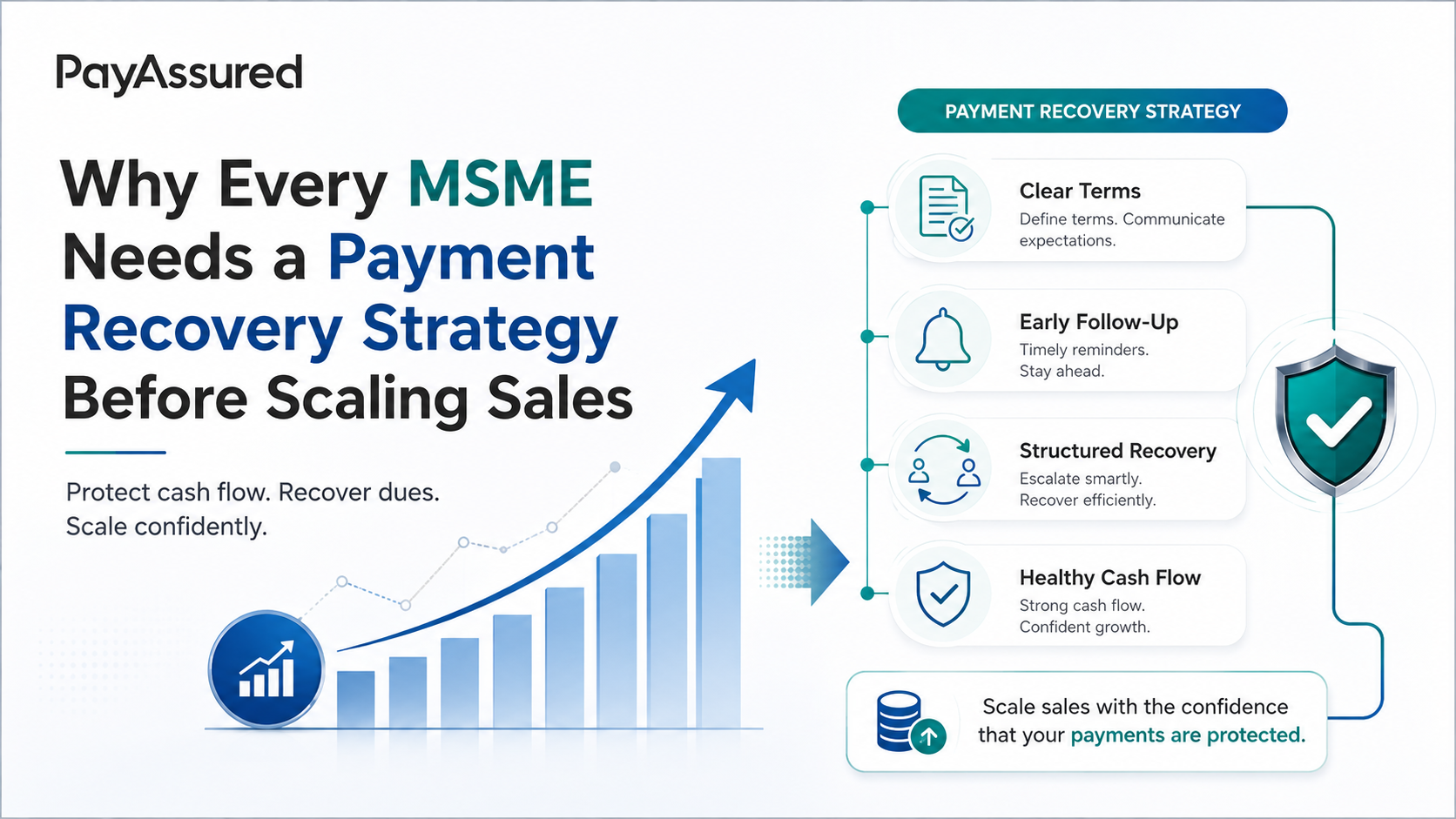
A structured approach to MSME delayed payment recovery helps prevent this situation. It allows an MSME to track overdue invoices, identify risky clients, follow up on time, document every communication and escalate matters before they become bad debts. Recovery should not start only after months of delay. It should be part of the business system from the beginning.
PayAssured helps MSMEs build this discipline.
Instead of allowing delayed payments to remain stuck in random follow-ups, PayAssured helps businesses create a structured recovery process. Each case is reviewed based on the outstanding amount, invoice age, payment terms, communication history, debtor behaviour and available documents. This gives the business clarity on which payments are delayed, which are at risk and which need immediate action.
For MSMEs, documentation is especially important. Invoices, purchase orders, delivery proofs, work completion records, ledger statements, email confirmations, WhatsApp messages and payment commitments can all become important during recovery. When these records are organized properly, the business is in a stronger position to recover its dues professionally.
A strong recovery strategy also helps MSMEs avoid emotional decision-making. Many owners personally follow up with clients because the money is important for daily operations. But repeated chasing can become stressful and time-consuming. It can also affect the tone of the relationship. PayAssured helps by bringing professional communication, clear timelines and structured follow-up into the process.
This does not mean recovery has to be aggressive. In fact, professional recovery protects relationships better than scattered reminders and frustrated calls. PayAssured's approach is designed to create seriousness while maintaining business dignity. The debtor understands that the matter is being handled properly, and the MSME gets a clear path towards payment resolution.
As an MSME scales, payment discipline becomes even more important. A single delayed invoice may be manageable. But multiple delayed payments across several clients can block working capital and slow the entire business. If receivables keep growing faster than collections, the business may be forced to borrow money, delay vendor payments or reduce new orders despite having strong demand.
This is why scaling without an MSME delayed payment recovery plan can be dangerous. Growth should not only mean more sales. It should mean stronger cash flow, better receivable control and more predictable collections. An MSME that recovers delayed payments on time can accept new orders confidently, invest in expansion, pay vendors faster and operate with less financial stress.
PayAssured supports this by helping MSMEs move from pending payments to structured recovery. Some cases may need professional follow-up. Some may require negotiation. Some may need a written payment plan. Some may require legal-backed communication or escalation. The right approach depends on the facts of the case, and PayAssured helps businesses choose that approach at the right time.
For Indian MSMEs, delayed payments are one of the biggest barriers to stable growth. A company may have good products, strong clients and increasing sales, but if money is stuck in receivables, the business remains vulnerable. Scaling sales without improving recovery is like filling a bucket that has a leak.
The smarter approach is to build a delayed payment recovery discipline before the business grows too fast.
PayAssured helps MSMEs do that. It gives them a professional recovery partner that understands unpaid invoices, delayed payments and B2B receivables. It helps protect working capital, reduce bad debt risk and turn sales into actual cash flow.
In the end, every MSME wants to grow. But growth should not come at the cost of financial stability. Before scaling sales, businesses must make sure they have a system to recover what they have already earned.
Because real growth is not just about raising more invoices.
It is about getting paid for them.