

The 30-60-90 Day Rule: When an Unpaid Invoice Becomes a Serious Recovery Case
- 1st July, 2026
- Meera
In business, every unpaid invoice has a timeline. At first, it looks like a normal delay. Then it becomes a repeated follow-up. Eventually, if not handled properly, it turns into a serious recovery case. Many companies fail to understand this transition early enough, and that delay is often what makes recovery harder.
For most Indian businesses, especially MSMEs and B2B service providers, unpaid invoices are not unusual. A client may ask for a few extra days. The finance team may say the payment is under process. The approval may be pending with management. The accounts department may request documents again. At the beginning, these reasons may sound genuine. But when the same delay continues for weeks and months, the business must stop treating it as a simple pending payment.
This is where the 30-60-90 day framework becomes important.
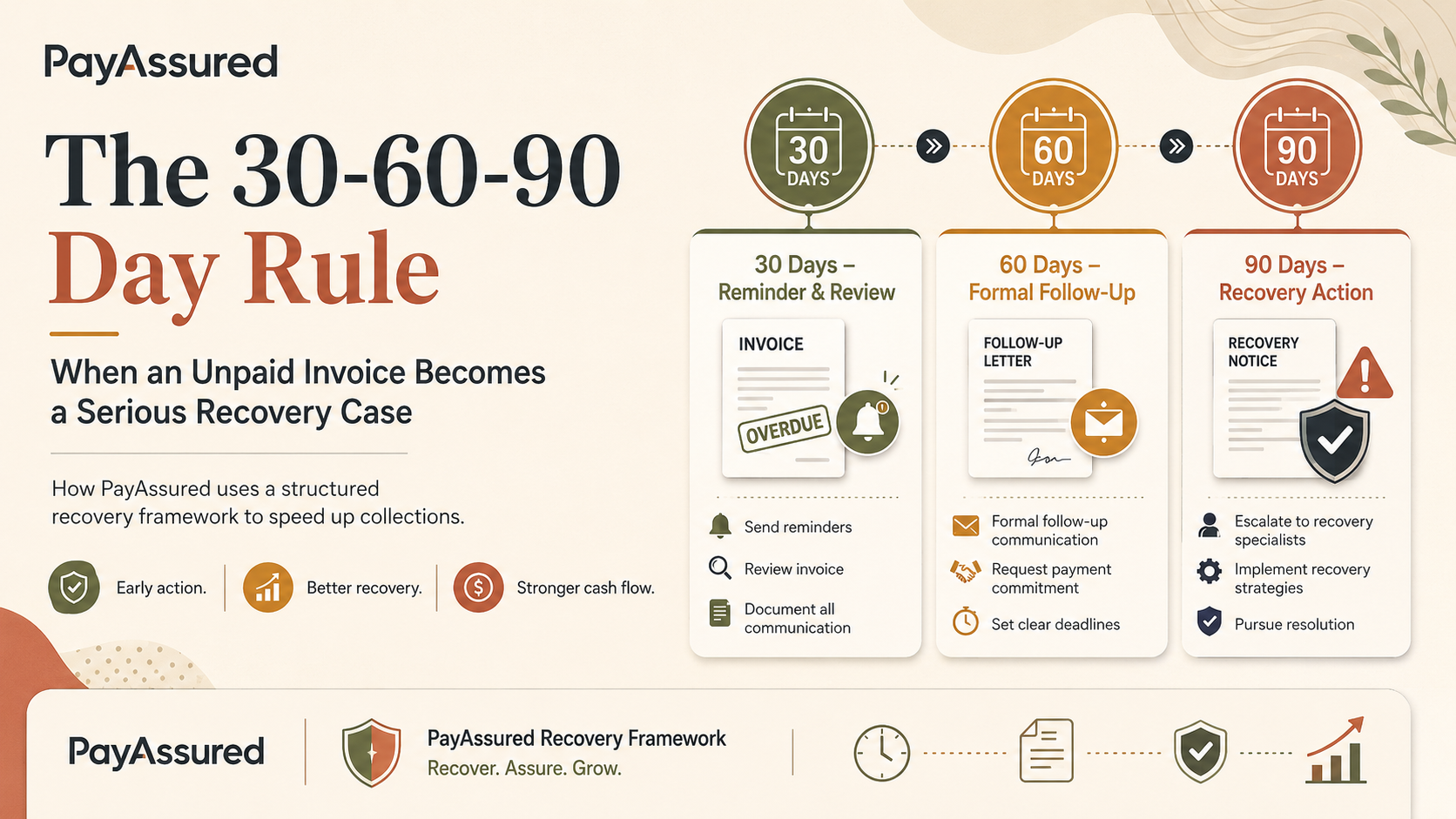
The first 30 days after an invoice becomes due are usually the reminder stage. At this stage, the business may still assume that the delay is operational. The client may be facing internal approval issues, cash flow timing problems, or documentation gaps. A polite reminder, a statement of account, or a formal follow-up may be enough to move the payment. But even at this stage, the business must maintain proper records. Every email, every call summary, every promise of payment and every shared document matters. A casual follow-up without documentation may feel convenient in the moment, but it weakens the business later if the matter escalates.
PayAssured treats this early stage as the point where recovery discipline begins. Instead of allowing businesses to send random reminders, PayAssured helps them understand the status of the invoice, review the available documents, check whether the payment delay is genuine or avoidable, and create a structured follow-up approach. This prevents the matter from becoming vague. The debtor is made aware that the creditor is serious, organized and tracking the payment professionally.
Once the invoice crosses 60 days, the situation changes. A delay that continues for two months is no longer just an accounting issue. It starts affecting cash flow, vendor commitments, working capital and business confidence. At this stage, repeated verbal assurances should not be treated as enough. If the debtor is still saying "next week," "under process," or "approval pending," the business must ask for clear written commitments and a specific payment plan.
This is where PayAssured's framework becomes more active. At the 60-day stage, PayAssured focuses on creating pressure without immediately damaging the commercial relationship. The recovery process becomes more formal. Documentation is organized, outstanding amounts are clearly calculated, communication is structured, and the debtor is approached with seriousness. The purpose is to move the case out of casual follow-ups and into a proper recovery conversation.
Many businesses lose time during this stage because they continue hoping the client will pay voluntarily. They do not want to sound aggressive. They do not want to lose the relationship. They do not want to involve a third party. But the truth is that professional recovery does not have to be aggressive. A structured approach can actually protect the relationship by keeping the communication clear, documented and commercially reasonable.
PayAssured helps businesses apply this balance. The objective is not to create unnecessary conflict, but to create movement. The debtor must understand that the creditor is no longer simply waiting. The matter is being reviewed, tracked and handled through a recovery process. This shift often changes the debtor's behaviour. When there is no pressure, delayed payments remain delayed. When there is structured pressure, payment discussions become more serious.
By the time an invoice crosses 90 days, the matter becomes a serious recovery case. At this point, the delay has already affected the business. The debtor has had enough time to clear the dues, provide a payment plan or raise genuine objections. If none of these have happened, the creditor must treat the matter with urgency. Waiting further can increase the risk of non-recovery.
Old invoices become harder to recover because urgency fades. The debtor becomes more comfortable delaying. Internal records may become difficult to trace. Employees who handled the transaction may leave. Communication trails may get scattered. The longer the business waits, the more complicated the recovery can become. This is why PayAssured considers the 90-day mark as a critical point for escalation.
At this stage, PayAssured helps businesses move into a stronger recovery process. This may include legal-backed communication, formal demand, settlement discussions, repayment planning, documentation support and escalation strategy where required. The recovery process becomes focused on converting the overdue invoice into a concrete outcome. That outcome may be immediate payment, a structured settlement, a written commitment, or further legal action depending on the facts of the case.
The strength of the 30-60-90 day framework is that it prevents businesses from reacting too late. Instead of waiting for an invoice to become a bad debt, the framework gives a clear timeline for action. The first 30 days are used to remind, record and verify. The next 30 days are used to formalize, pressure and seek commitment. After 90 days, the matter is treated as a recovery case that requires serious action.
This structured method makes recovery faster because it removes confusion. Businesses often lose time because they do not know when to escalate. One person in the company may think the payment will come soon. Another may want to send a legal notice. The sales team may want to preserve the relationship. The finance team may want immediate payment. The founder may be tired of chasing. Without a clear framework, decisions get delayed.
PayAssured brings clarity to this process. It helps businesses understand where the invoice stands, what action is appropriate, and how quickly the matter should be escalated. This allows the creditor to act with confidence instead of emotion. It also sends the debtor a clear message that payment delay will not be ignored indefinitely.
Another reason the framework improves recovery is that it helps preserve evidence from the beginning. A recovery case is only as strong as the documents supporting it. Invoices, purchase orders, work orders, delivery proofs, emails, WhatsApp confirmations, ledger statements, balance confirmations and prior payment records all become important. When PayAssured gets involved early, these documents can be reviewed and organized before the matter becomes messy.
For many businesses, this is one of the biggest advantages. They may have a genuine claim, but their documents may be scattered across departments. Sales may have some communication. Accounts may have invoices. Operations may have delivery proof. Management may have verbal commitments from the debtor. PayAssured helps bring this information together and build a cleaner recovery position.
The 30-60-90 day rule also helps businesses avoid emotional decision-making. When money is stuck, it is natural for business owners to feel frustrated. But recovery works better when action is structured, not impulsive. A professional recovery partner ensures that communication remains firm, clear and legally aware. This improves the chances of settlement and reduces unnecessary escalation.
In the Indian B2B environment, delayed payments are often treated too casually. Many companies accept long payment cycles as normal. But accepting delay as normal can slowly damage the business. It blocks cash flow, weakens working capital, affects planning and creates unnecessary stress. A business that acts early is better protected than a business that waits until the debt becomes old and difficult.
PayAssured's 30-60-90 day framework is built around this simple principle: the earlier a business acts, the stronger its recovery position becomes. By identifying risk early, documenting the claim properly, communicating professionally and escalating at the right time, PayAssured helps businesses move from passive follow-ups to active recovery.
An unpaid invoice should not be allowed to sit quietly for months. Every delay has a cost. Every ignored reminder reduces urgency. Every vague promise without payment increases risk. The business must know when to wait, when to follow up, when to formalize, and when to escalate.
The 30-60-90 day rule gives businesses that discipline.
For PayAssured, recovery is not about waiting until the situation becomes impossible. It is about creating a structured path from the first delay to final recovery. When handled properly, unpaid invoices can be acted upon before they become bad debts. Cash flow can be protected before pressure becomes severe. Debtors can be pushed toward resolution before the matter loses momentum.
In the end, an invoice does not become a serious recovery case overnight. It becomes serious when delay is allowed to continue without action. The 30-60-90 day framework helps businesses recognize that moment early and respond with the right level of seriousness.
That is how PayAssured makes recovery faster, more structured and more effective for businesses dealing with unpaid invoices.


